 Home
Home

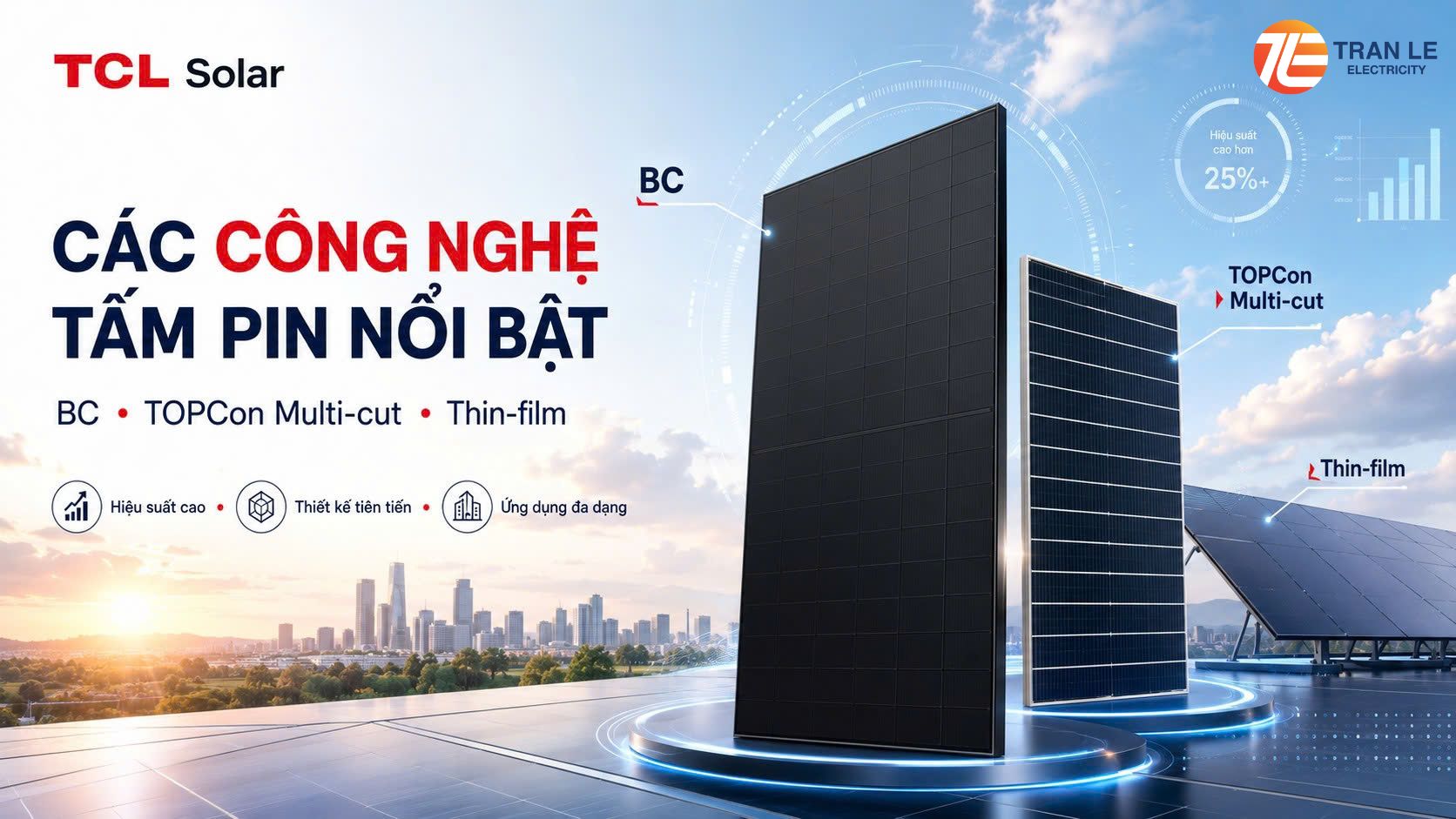
The renewable energy market is witnessing breakthrough evolutionary leaps. While users previously heard terms like Poly, Mono, or PERC, the landscape has completely shifted. The global PV industry has entered a brand-new era driven by higher-efficiency solar panel technology generations. Core innovations now include Back Contact, TOPCon Multi Cut, and Thin Film.
Each engineering solution follows its own distinct development path. Some focus heavily on achieving ultimate conversion efficiency. Some optimize long-term components reliability and material durability. Meanwhile, other solutions are tailor-made for massive-scale projects or designed to maximize total module power output within a limited installation footprint.
Below are the 3 most discussed solar panel technology groups leading the global market trends.
Contents
- 1 1. Back Contact – The Premium Solar Panel Technology Pioneered By TCL Solar
- 2 2. TOPCon Multi Cut And Shingled – The New Trend For High-Efficiency N-Type Modules
- 3 3. Thin Film – A Specialized Solar Panel Technology For Large-Scale Fields
- 4 Quick Comparison Matrix Of Solar Panel Technology Options
- 5 Which Solution Fits The Vietnam Market Best?
- 6 Conclusion
- 7 Elevate Your Solar Energy System Today!
1. Back Contact – The Premium Solar Panel Technology Pioneered By TCL Solar
Back Contact (commonly referred to as BC) stands out as one of the most premium cell architectures in the modern PV industry. Unlike traditional cells where electrical gridlines run across both the front and back surfaces, this solution moves all or most of the metal contacts to the rear side. Consequently, the front surface can absorb sunlight more effectively since it is completely free from shading caused by metal busbars.
Deploying the Back Contact structure helps modules secure exceptional advantages:
-
Maximize light absorption area on the front surface.
-
Significantly enhance energy conversion efficiency.
-
Deliver superior aesthetic appeal with a sleek, uniform cell appearance.
-
Perfectly fit premium residential and C&I Rooftop sectors.
In this specific segment, TCL Solar holds a highly unique technological narrative. The brand inherits and advances the technological foundation from the SunPower and Maxeon ecosystem – global pioneers of IBC structure since 1985. The Back Contact module lines from TCL Solar represent a strategic integration of Maxeon’s IBC legacy and the massive Wafer manufacturing capabilities of TCL Zhonghuan.
Importantly, this is not just about efficiency; it is a race of extensive intellectual property. TCL Solar currently holds over 1,600 granted patents in the solar cell and module sector. Furthermore, the global patent licensing agreement between AIKO and TCL Solar allows AIKO to utilize Maxeon’s BC cell and module patents outside the US market. This partnership underscores the deep value and global influence of the BC platform that TCL Solar scales. Therefore, when discussing Back Contact, TCL Solar is recognized as a leader with the deepest solar panel technology foundation in the industry.
2. TOPCon Multi Cut And Shingled – The New Trend For High-Efficiency N-Type Modules
TOPCon (Tunnel Oxide Passivated Contact) is currently the most mainstream cell platform in the next-generation N-Type module era. Compared to traditional PERC, TOPCon offers superior efficiency, lower degradation rates, and enhanced performance under diverse environmental conditions. Continuous design upgrades have established this solution as a dominant solar panel technology worldwide.
Leading manufacturers are currently optimizing module layouts through innovative structures such as Multi Cut Cells, Shingled Layouts, and Overlapping Designs. Among these, the Multi Cut technique divides the solar cell into smaller pieces, which optimizes current flow and minimizes internal resistance losses within the panel. When combined with a Shingled (overlapping) structure, cell density increases within the same dimensions, thereby driving total power output to its maximum limit.
This engineering combination grants modules outstanding operational benefits:
-
Boost module power output within the exact same frame dimensions.
-
Thoroughly minimize internal electrical power losses.
-
Optimize real-world roof space utilization efficiency.
In this technology group, TCL Solar and Tongwei are two standout representatives. TCL Solar has developed a robust lineup of TOPCon Multi Cut Shingled products, such as the T5 Pro and S-Class, delivering power outputs up to 670W and module efficiencies reaching 24.8%. Concurrently, Tongwei is advancing its next-generation platform via the TNC 3.0 system, combining Overlapping Layouts to push power limits.
For the Vietnam market, this specific solar panel technology is exceptionally well-suited for projects that require strict roof space optimization, such as factories, logistics warehouses, commercial centers, or solar carports with limited structural footprints.
3. Thin Film – A Specialized Solar Panel Technology For Large-Scale Fields
Alongside crystalline silicon tracks, the PV sector features an entirely independent alternative route named Thin Film technology. Instead of utilizing traditional crystalline silicon wafers, Thin Film applies ultra-thin layers of semiconductor materials to absorb light. The most prominent thin-film variant deployed today is CdTe (Cadmium Telluride).
While Thin Film does not directly compete with premium crystalline rooftop modules regarding efficiency per square meter, it remains a vital solar panel technology possessing specialized traits for the Utility Scale segment:
-
Operate exceptionally well and maintain stable efficiency in high-temperature environments.
-
An independent supply chain separate from crystalline silicon, reducing supply risks.
-
Favorable carbon footprint profiles in strict regulatory markets.
However, because its module efficiency is typically lower than premium crystalline silicon systems, Thin Film requires a significantly larger land footprint to achieve the same total system capacity. Consequently, this engineering path remains a preferred choice for massive ground-mounted utility solar farms rather than rooftop industrial installations.
Quick Comparison Matrix Of Solar Panel Technology Options
| Technology Name | Key Representative Brands | Core Strengths | Ideal Applications |
| Back Contact | TCL Solar | Ultra-high efficiency, premium aesthetics, over 1,600 patents | Premium Residential, C&I Rooftop, Commercial |
| TOPCon Multi Cut | TCL Solar, Tongwei | High power output, space optimization, low resistance | Factories, Warehouses, Limited roof spaces |
| Thin Film | First Solar | Alternative materials, high heat resistance, independent supply | Utility Scale, Large-scale ground-mounted farms |
Which Solution Fits The Vietnam Market Best?
Depending on the specific characteristics and financial investment of each project, developers in Vietnam can select the most optimized path. For the factory, logistics warehouse, and carport sectors, enterprises should prioritize utilizing TOPCon Multi Cut solar panel technology to maximize power generation yield on the available roof surface area. For premium villas or high-end commercial rooftops, Back Contact stands out as the top choice due to its uniform gridless design and peak efficiency performance.
TCL Solar is currently a compelling brand in Vietnam by successfully mastering both of these core technological pathways. They provide the premium Back Contact line inheriting the SunPower and Maxeon legacy for the high-end segment, while simultaneously commercializing the next-generation TOPCon Multi Cut series to satisfy business demands for output optimization. Clearly, diversity in developing advanced solar panel technology allows this brand to comprehensively address every customer requirement.
Conclusion
Evidently, selecting equipment today is no longer just a simple assessment of the Wp number printed on the label. The ultimate factor deciding long-term financial success is the underlying solar panel technology driving the system, the R&D capacity of the manufacturer, and its precise compatibility with your project profile.
Elevate Your Solar Energy System Today!
Contact Tran Le Electricity now to receive detailed technical documentation and the best quotes in Vietnam for TCL Solar Panels.
Contact Information – Tran Le Electricity:
Contact to Tran Le Electricity:
-
Headquarters: 275-279 Dien Hong, Hoa Xuan, Cam Le, Da Nang.
-
Southern Branch & SAJ Service Center: No. 02, Street 27, Van Phuc Residential Area, Hiep Binh Phuoc Ward, Thu Duc City, Ho Chi Minh City.
-
Hotline: 0939 792 428 – Ms. Kim.
-
Website: Tran Le Electricity
- Fanpage: Tran Le Electricity